
Put the entropy source inside your own product.
For OEM and semiconductor teams carrying the entropy source on their own board. Two photonic engines in production: one built for throughput, one built for volume and cost.

Different physics, the same measurement discipline.
Ruby™ N1 is built for throughput; Ruby™ S1 is built for volume and cost. They use different quantum-optical mechanisms on purpose. What they share is the property that made both worth building: a physical process with a model you can write down, and therefore measure a device against.
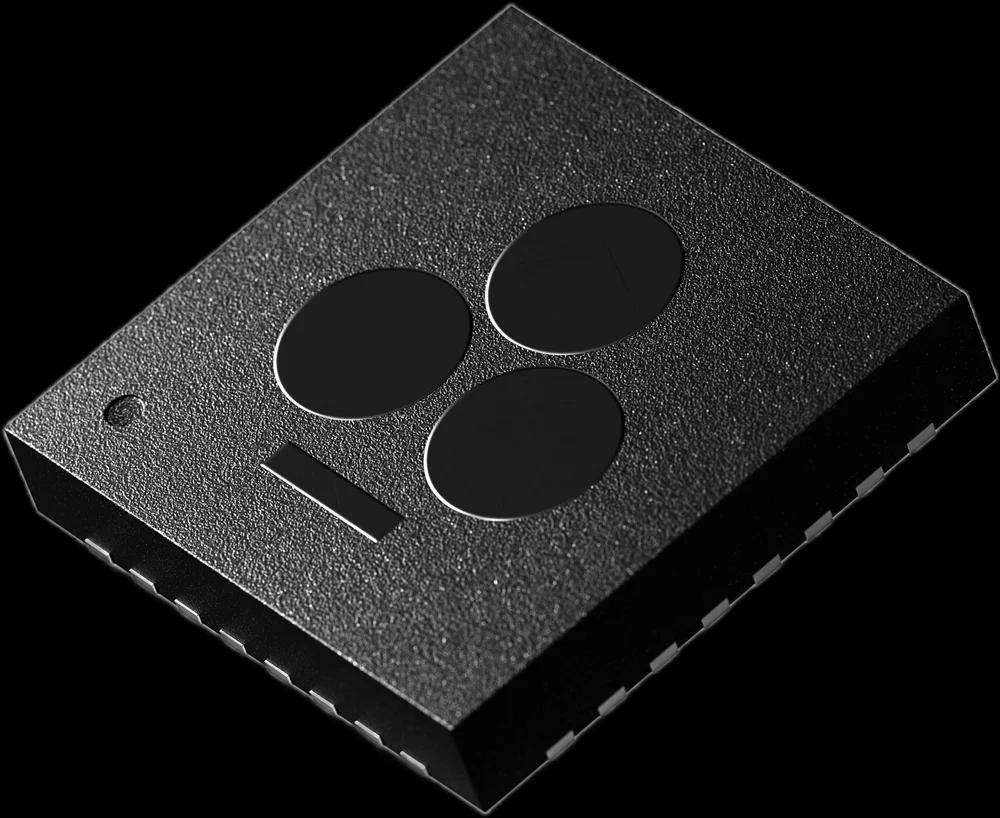
Ruby™ N1
A monolithic photonic chip whose randomness originates in quantum phase diffusion. The optical phase of the laser field will not hold still: spontaneous emission nudges it at random, and the phase performs a random walk. Gain-switching the laser is what makes that walk useful — with the cavity depleted below threshold the phase diffuses fastest and no memory of the previous pulse survives, so one independent sample comes out per cycle.
- Mechanism
- Quantum phase diffusion, gain-switched
- Throughput
- Up to 1 Gbit/s
- Manufacturing
- Dedicated photonic line, US and European foundry supply
- Used in
- Garnet™ PCIe and Nellite™ FMC products
- Environmental evidence
- Qualification evidence supporting GEO conditions
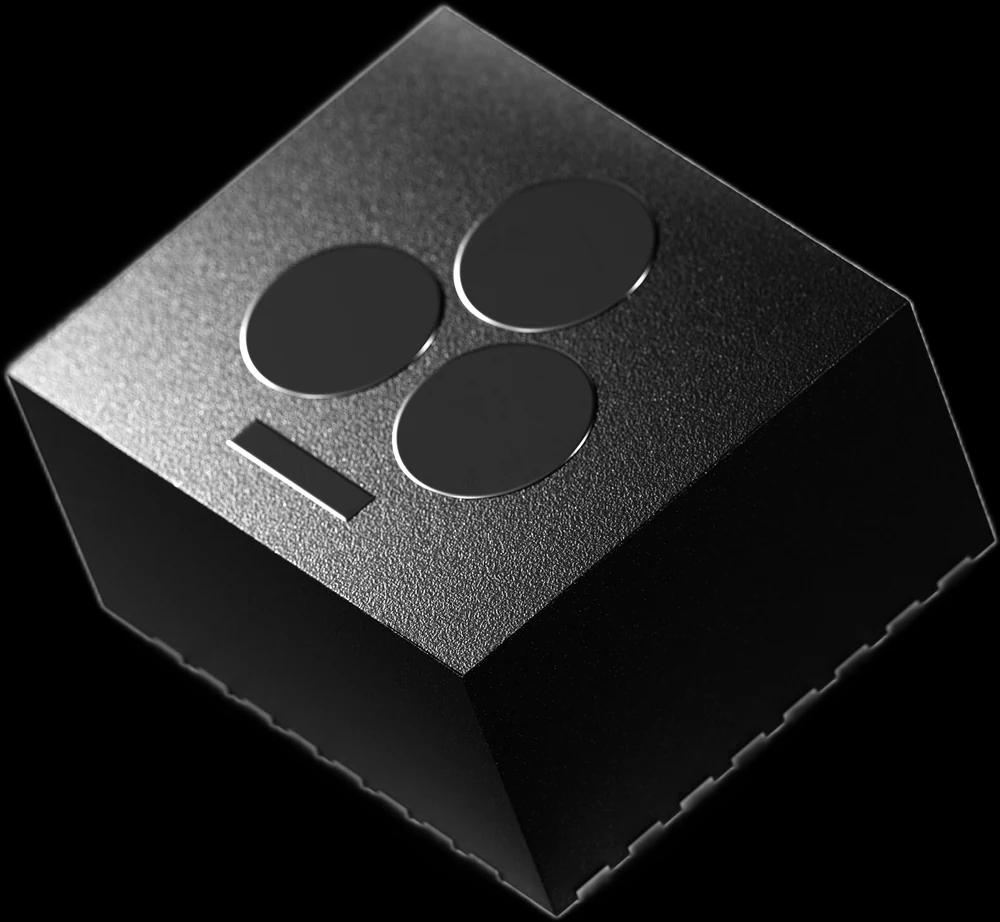
Ruby™ S1
A VCSEL — the same device class used for face recognition and proximity sensing in phones — switches its output at random between two polarisation states. A polariser between the laser and the photodetector passes one of those states and blocks the other, so the detector sees a random sequence of light-or-no-light events. Coherent supplies the VCSELs and the material, and choosing a component with a consumer-scale supply chain is what makes a much lower size, power and cost point credible.
- Mechanism
- Polarisation switching from a VCSEL
- Optimised for
- Volume and cost
- Supply
- VCSELs and material supplied by Coherent
- Used in
- Onyx™ S1 and Onyx™ X5 modules
- Module throughput
- 50–100 Mbit/s as delivered in Onyx™ S1
- Chip-level figures
- Available on request — ask an engineer
Randomness from a phase that will not hold still.
Quantum phase diffusion, in the order it happens. The unpredictability is created in the first step and preserved by the rest; what makes it useful in a security architecture is that each step has a physical model behind it, which is what a device can then be measured against.
- 01
The phase will not hold still
Spontaneous emission inside the laser is a quantum process: it adds light at random moments, each nudging the phase of the field. The phase therefore performs a random walk rather than advancing predictably. That walk is phase diffusion, and it is the only step in this list where unpredictability is created — everything after it is engineering to get the result out at speed.
- 02
Emptying the cavity each cycle
The drive current is swung from below the lasing threshold to well above it, once per cycle. Below threshold the field decays away, so no phase memory of the previous pulse survives and the next pulse starts from a fresh seed. It is also where diffusion is fastest, because the rate rises as the cavity empties. This is what makes consecutive samples independent, and it sets the rate: one sample per cycle.
- 03
Amplifying without touching the phase
Driving back above threshold amplifies that faint seed into a bright pulse by stimulated emission. The amplification is phase-insensitive, so the pulse keeps the random phase it started with, while gain saturation brings every pulse to nearly the same brightness. The quantum quantity now rides on a bright optical signal — which is why this reads out on an ordinary photodiode rather than needing single-photon detectors.
- 04
Turning phase into something measurable
A single field’s absolute phase cannot be measured — only a phase difference between two fields can. So the light is interfered with a second field, and that difference becomes an intensity: bright where they add, dim where they cancel. Photodetection on the same chip turns it into a photocurrent.
- 05
Digitising, and counting only what is quantum
Quside mixed-signal electronics sample the photocurrent and produce the bitstream. One raw sample comes out per cycle, and a raw sample is not a random bit: it is not uniform, and it carries noise from the detection electronics alongside the quantum phase. The figure that matters for a security argument is the entropy per sample established within the physical model — which is what an SP 800-90B assessment quantifies, and it is lower than the raw sample rate.
Ruby™ S1 reaches the same assurance model by a different physical route — polarisation switching from a VCSEL — which is why the measurement discipline is described once, for both. Both mechanisms, side by side.
Fabless design, US and European photonic supply.
Quside designs photonic and electronic chips and outsources fabrication, then runs production and final test in-house. Photonic foundry supply runs through both US and European foundries, chosen for resilience.
Dedicated photonic line
Ruby™ N1 is a monolithic photonic chip built on a dedicated line, which is what makes the process repeatable enough to measure devices against a model.
US and European foundry supply
Photonic foundry supply for the N1 route runs through both US and European foundries, chosen for resilience. For a programme with sovereignty constraints, that is part of the technical answer rather than a footnote.
VCSEL supply
Coherent supplies the VCSELs and the material for the S1 route — a component class already built at consumer scale.
Test and production
Production and final test run in-house, so the measurement discipline described on this page is the one applied before a unit leaves.

What comes with the engine.
An engine on its own is a source of bits. What makes it useful in a security architecture is the measurement built around it, and that comes with the chip.
- 01Physical process
A quantum-optical process with a written-down physical model generates the raw signal.
- 02Measurement
On-device metrology samples the parameters that describe how that process is behaving.
- 03Entropy estimate
Entropy is quantified within the defined physical model, rather than inferred from output statistics alone.
- 04Health state
The device reports whether it remains inside its validated operating conditions.
- 05Audit output
That health record is available to the host, so operations and compliance can inspect it.
The engine reports its own health continuously — one input to your security posture, alongside key management, protocol design and implementation quality. How Locally Verified Entropy works.
Evidence your assessor will accept.
Evidence travels with the engine, each piece carrying the scope it was issued under — so you can quote them in a submission and see exactly where your own qualification work starts.
NIST SP 800-90B
- Scope
- The entropy source in Quside PCIe One and FMC One.
- Establishes
- An entropy source validated against the SP 800-90B requirements, on a public register, with Ruby™ N1 as the engine inside it. It is the part of an entropy submission that takes longest to build, already built.
- What it does not cover
- Your own product’s validation path, once the engine is on your board. The certificate covers the products it was issued for and the entropy source rather than a complete random bit generator, so the route for your part is yours to walk — and it is far cheaper to plan before the design freezes. Bring us the target and we will map it with you.
Space qualification
- Scope
- Ruby™ N1 under GEO conditions.
- Establishes
- Environmental and lifetime evidence for the entropy engine, generated in a real programme — usually the evidence a space bid is missing.
- What it does not cover
- The mapping to your mission profile. This is programme evidence rather than a general certificate, and it supports GEO conditions specifically — so confirm which parts of the set carry to your profile before it goes into a bid.
What a chip engagement involves.
It runs as a programme rather than a purchase order, and it starts on a bench.
Start on a module
Almost every chip engagement begins with Garnet, Nellite or Onyx on a bench. The measurement behaviour, the software and the evidence are the same, so the learning is not thrown away when the design moves to a die.
Drivers, SDK and APIs
Linux C and Python drivers for the PCIe products and VHDL IP cores for FPGA fabrics. The host-side work is shared across the family.
Engineering work where the design needs it
Where an integration needs work that does not exist yet, it is scoped and quoted up front as an engagement rather than discovered halfway through.
Reference material
Integration material is issued against a specific design and written for your board, not for a generic example.
Partners in the path
Lattice for root-of-trust silicon, Coherent for VCSEL supply, PQShield and Keyfactor on the cryptographic and PKI side. Where a partner is part of your architecture, say so early and the conversation gets shorter.
Expected effort
Measured in programme phases rather than sprints: evaluation, design-in, qualification, production. The qualification phase is the one most often under-planned, because it depends on evidence rather than on engineering hours.
Where the chip changes the design.
Decisions about where the entropy source lives in a bill of materials.
Chip-down entropy on your own board
When the module is a component you would rather not carry, the engine goes on your PCB directly. The measurement discipline travels with it, reported to whatever host you design around it.
One source across a product family
A high-throughput engine at the top of the range and a volume engine at the bottom, sharing a measurement model and a software story. Qualification work done once is reused rather than repeated per SKU.
Volume at the low end of the range
Ruby™ S1 runs on VCSELs and material supplied by Coherent — a component class built at consumer scale. That supply chain is what makes the size, power and cost point credible when you are shipping many units.
Long-lifecycle and sovereign programmes
US and European photonic foundry supply, production and final test in-house, and qualification evidence for Ruby™ N1 supporting GEO conditions. Programmes that will still be flying in a decade ask about all three.
What to ask for.
Chip material is written against a specific design, so it is issued to a named integration. Say which one you need.
Ruby™ N1 and S1 chip documentation
On requestElectrical, optical and integration material, written for the design you are placing the engine into.
Qualification and evidence pack
On requestThe entropy-source architecture and health-test documentation a laboratory or certification body will ask for.
Certificate scope summary
PublishedWhat E178 covers, and why a product certificate does not attach to a die.
Start with an engine on your bench.
If entropy is going into a product generation you are architecting now, open the design discussion and put a module in front of your engineers while it runs. The measurement behaviour and the software are the same ones you will ship.