
Key material generated inside the appliance, by a source that reports its own health.
HSM, PKI, key management platforms and security appliances generate key material continuously, under load, from a source they usually cannot see. Quside puts a local, measurable entropy source in the same chassis, with the certificate scope stated for the part number you are buying.
Who usually specifies it
- Security appliance OEMs
- Data-centre infrastructure suppliers
- HSM vendors
- PKI and key management teams
- Platform security architects
What is driving it
Entropy assurance is moving from an implementation detail to a written procurement requirement in regulated infrastructure. Qualify a source once and it carries across the product line, not just the unit in front of you.
The one input nobody can inspect.
Every other stage of a key lifecycle produces evidence. Generation, rotation and destruction are logged, reviewed and audited. The entropy underneath is asserted once, at procurement, and then assumed for the life of the device.
Validated once, then assumed
An entropy source is typically tested before deployment and the result travels with the product for the life of the device. Temperature, voltage and ageing move a physical source. SP 800-90B requires continuous health tests, but no scheme defines an operator-visible health interface, so that movement is rarely reported anywhere an operator can see it. The first sign of a problem tends to appear downstream, in a key.
Seeding and reseeding under load
Approved DRBGs depend on strong seeding, correct construction and appropriate reseeding from trusted entropy sources. A key management platform generating material continuously needs that dependency to be met continuously — and needs to be able to show that it was.
Availability cannot depend on a network
An appliance that has to reach outside its own chassis for randomness inherits a latency, availability and sovereignty dependency it does not control. Randomness arriving over a network also cannot be verified at the point where it is used.
The integration cost lands on a shipping product
Adding a component to an appliance already deployed across enterprise infrastructure means drivers, support, regression testing and a re-qualification conversation. The entropy argument has to survive that cost, not just the technical review.
Certificate scope is easy to over-read
A certificate number often stands in for an architecture during procurement. An entropy source validation is a component result; it is not a complete random bit generator and it says nothing about the system above it. Buyers and vendors both get caught by this.
Post-quantum work reopens the whole stack
Products are being redesigned for new algorithms anyway. That is a rare moment when the physical foundation is on the table — and a rare moment when getting it wrong is baked in for another product generation.
The systems this goes into.
The integration point and the acceptable form factor change from one to the next. The entropy question does not.
HSM and PKI infrastructure
A hardware security module or certificate authority is judged on the strength of the key material it issues, and on its ability to evidence that strength to an auditor years later. Entropy is the input it can least afford to guess about.
A local entropy source in the same chassis, measured against a defined physical model while it runs, with a health record the host can read and retain.
Garnet™ Plus A41 · Onyx™ S1
Security appliances
Firewalls, VPN concentrators and secure gateways generate session keys and nonces at line rate. Entropy has to be available at that rate without a network dependency, and without a redesign of the data plane.
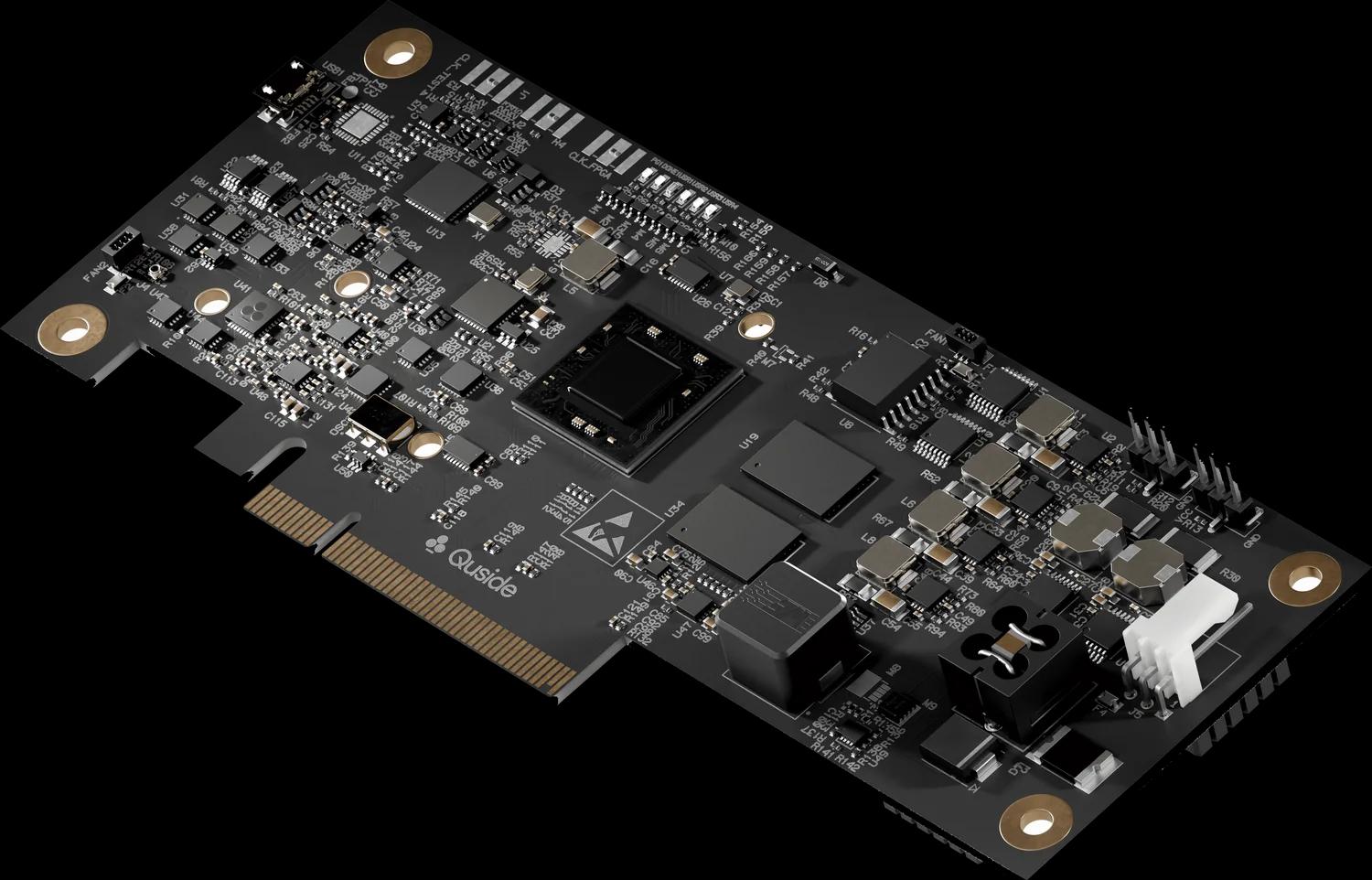
A PCIe card for appliances built on standard server boards, an FMC module where the data plane is an FPGA, or a compact embedded module where the design is space-constrained.
Garnet™ Plus A41 · Nellite™ Plus A41 · Onyx™ S1
Key generation and lifecycle
Generation, rotation, escrow and destruction are audited as a lifecycle. The entropy underneath is usually the only stage in that lifecycle with no runtime evidence attached to it.
The runtime loop runs in order: physical process, measurement, entropy estimate, health state, audit output. The final stage is the one operations and compliance teams actually consume.
Any Quside entropy source
Post-quantum migration
FIPS 203, 204 and 205 were finalised in August 2024. Key generation, encapsulation and signature nonces in those schemes all consume randomness, and a correctly implemented scheme seeded from a degraded source produces keys weaker than the parameter set advertises.
PQC algorithms and entropy assurance solve different parts of the same cryptographic architecture. Quside supplies quantum entropy that strengthens both classical and post-quantum cryptographic systems, at the moment the stack is open on the bench anyway.
Garnet™ Plus A41
Cloud and data-centre infrastructure
Fleet operators need an entropy story that is uniform across racks, that survives a hardware refresh, and that does not add an external service to the dependency graph of the platform.
A low-profile PCIe Gen2 ×4 card with Linux C and Python drivers, deployed per server or per appliance so the trust boundary matches the machine. Quside does not deliver entropy as a network or cloud service.
Garnet™ Plus A41
Financial services
Payment, custody and settlement infrastructure runs on the same architecture as the rest of this segment: HSMs, certificate authorities, key management platforms and hardened appliances, operated under audit and refreshed on a slow hardware cycle.
What is different is the reporting burden. An auditor asking how key material is generated is asking a question the entropy source itself can answer, if it was designed to produce a health record rather than only a bitstream. The runtime loop ends in an audit output for exactly that reason.
References are handled as calls under NDA, not as published case studies. Tell us what your procurement process has to see and we will set one up.
Where the source sits depends on your trust boundary.
The same photonic engine reaches the host, the FPGA fabric or your own board. Which one you pick follows from where your product draws that boundary.
| Position in the system | What it does | Quside part |
|---|---|---|
| Physical source | Quantum phase diffusion in a monolithic photonic chip: the optical phase of the laser field performs a random walk, and interference turns it into an intensity the device digitises into bits. | Ruby™ N1 (up to 1 Gbit/s) · Ruby™ S1 for compact modules |
| Runtime measurement | On-device metrology measures the physical process against its model and estimates entropy, then reports whether the source remains inside its validated operating conditions. | Built into every Quside entropy product |
| Host integration | The card presents entropy to the platform and exposes the health state to the operating system, so the seeding path and the evidence path are the same path. | Garnet™ Plus A41 with Linux C and Python drivers |
| Data-plane integration | For appliances whose crypto or packet path runs in an FPGA, entropy is taken directly into the fabric rather than through the host. | Nellite™ Plus A41 with VHDL IP cores |
| Inside the product | Where the appliance is its own board rather than a server, the entropy source becomes a component of that board. | Onyx™ S1, built on Ruby™ S1 |
The entropy source feeds an approved deterministic mechanism, which is what a consuming application actually calls. SP 800-90C, final in September 2025, describes that construction and connects an SP 800-90B validated source to an SP 800-90A mechanism.
Evidence a qualification team can quote.
Each piece with the scope it was issued under, in wording that goes straight into a submission.
NIST SP 800-90B
- Scope
- Quside PCIe One and FMC One.
- Establishes
- The entropy source has been validated against the SP 800-90B requirements for entropy sources.
- What it does not cover
- It covers the entropy source, not a complete random bit generator, and not the systems built on top of it. SP 800-90C, final in September 2025, describes how a validated source combines with an approved deterministic mechanism.
ENS
- Scope
- Quside PCIe One and FMC One, version 1.0, under the Spanish national security framework.
- Establishes
- Qualification for use in Spanish public-sector systems categorised up to Alta, the highest of the three ENS categories.
- What it does not cover
- Covers Quside PCIe One and FMC One at version 1.0. Scope is per product and per version, so confirm the part number your programme is specifying against the catalogue record.
Shipped with Garnet™ Plus A41.
Included with Nellite™ Plus A41.
Form factor and trust boundary decide before entropy rate.
Most appliances need far less than a gigabit per second. What they need is for it to be present, local and inspectable.
| Product | Choose it when | Integration | Entropy rate | Status |
|---|---|---|---|---|
| Garnet™ Plus A41 | The product is a server, an appliance on a standard server board, or a data-centre platform with a spare low-profile slot, and you want the shortest path to an evaluation. | PCIe Gen2 ×4 · Linux C and Python drivers | Up to 1 Gbit/s | Available |
| Nellite™ Plus A41 | The cryptographic or packet path lives in an FPGA and you want entropy inside the fabric rather than crossing the host bus. | FMC LPC/HPC and FMC+ · VHDL IP cores | Up to 1 Gbit/s | Available |
| Onyx™ S1 | The appliance is a custom board, size and power matter more than peak rate, and the entropy source has to become a component of your own BOM. | Embedded module · built on Ruby™ S1 | 50–100 Mbit/s | Available |
What you can verify today.
The certificates above are public and can be checked independently. Everything else, you get by putting a unit on your bench or talking to the engineers.
Reference calls and technical sessions under NDA
Customer references in this segment are given as calls rather than case studies. Where a customer has agreed to take one, we arrange it under NDA. An evaluation kit ships alongside it, with an engineering session on your seeding path, your reseeding policy and the health reporting your auditors ask for.
Other systems we build for
Start with the seeding path.
Tell us where key material is generated in your product, what the reseeding policy is, and what an auditor asks you for today. That is usually enough for a first architecture review and a clear answer on which module to evaluate.