
An entropy source that outlives the cryptography running on it.
Network and industrial systems are specified for a service life measured in decades and refreshed slowly. Cryptographic renewal, secure provisioning and trusted key generation all have to keep working across that span — from a source that stays inside the equipment.
Who usually specifies it
- Telecom equipment vendors
- Network operators
- Critical-infrastructure suppliers
- Secure network architects
- Product security teams
What is driving it
An operator writes local, verifiable entropy into a requirement; the equipment vendor is the one who has to satisfy it in hardware. Qualify the source once and it carries across the product family.
The hardware outlasts the assumptions built into it.
Equipment is specified once and lives a long time; the cryptography it depends on is being renewed now, and will be renewed again. Whatever produces the key material has to survive both cycles and stay inspectable throughout.
The equipment outlives its cryptography
Network and industrial hardware is specified for a long service life and refreshed slowly. The cryptographic assumptions it shipped with will not hold for that whole period, so the ability to renew has to be designed in rather than retrofitted.
Provisioning happens far from the factory
Devices are keyed and re-keyed in the field, at scale, often unattended. Every one of those operations consumes randomness, and if the source is weak or unavailable at that moment the resulting identity is weak for the life of the device.
A network dependency is a fragility
Randomness delivered from outside the equipment adds an availability and latency dependency to a system whose entire purpose is to keep working. It also cannot be verified where it is used, which is the property that matters.
Sovereignty is now written into requirements
Operators and national infrastructure programmes increasingly need to say where the cryptographic root of a system physically sits, and who could observe or influence it. That is an architectural question before it is a compliance one.
Regulatory direction is set, timing is tight
FIPS 203, 204 and 205 were finalised in August 2024. ANSSI has stated that post-quantum cryptography should enter product qualification from 2027 and that buying products without PQC after 2030 will not be reasonable — a strong procurement signal rather than a universal legal ban.
Scale multiplies small integration costs
A component decision that costs a little in board area, power or software support is multiplied by every unit in a network. The entropy argument has to hold at the unit economics of a product line, not a pilot.
The equipment this goes into.
Different equipment, different environments, one shared property: the cryptographic root has to be inside the box and has to be able to report on itself.
Telecom networks
Core and access equipment terminates enormous numbers of secure sessions and provisions subscriber and device identities continuously. The randomness behind all of it is generated inside boxes that were never asked to report on it.
A local entropy source in the equipment itself, measured against its physical model at runtime, available as a PCIe card on standard server boards or as an embedded module inside a purpose-built line card.
Garnet™ Plus A41 · Onyx™ S1
Network security
Session establishment, certificate issuance and tunnel re-keying are the highest-frequency consumers of key material in a network, and they run under load exactly when the network is under stress.
Entropy that is present locally at the rate the data plane needs it, with a health state the platform can read, so degradation is visible rather than inferred after the fact.
Garnet™ Plus A41 · Nellite™ Plus A41
Industrial and critical systems
Energy, water, transport and manufacturing systems combine long-lived controllers with a low tolerance for downtime and an environment that is not a data centre. Retrofitting a security function is expensive and often impossible.
A compact embedded entropy source sized for controller-class hardware, at 50–100 Mbit/s and a board area a controller can actually spare.
Onyx™ S1
Sovereign infrastructure
National programmes need to state where the cryptographic root of an infrastructure sits, who manufactures it, and whether the supply behind it can be sustained.
A locally generated source inside the customer trust boundary, from a Barcelona-based fabless company that designs its own photonic and electronic chips, with US and European foundry supply behind them, chosen for resilience, and the ENS Alta qualification for Quside PCIe One and FMC One.
Garnet™ Plus A41 · Nellite™ Plus A41
The algorithm layer changes faster than the hardware under it.
Crypto agility is usually discussed as an algorithm problem. Algorithms are the part that changes fastest, and they sit on a physical layer that is far harder to replace. That layer is the one worth getting right while the product is open on the bench.
Replaceable, on a known schedule
- FIPS 203, 204 and 205 were finalised in August 2024: ML-KEM and two signature schemes.
- SP 800-90A specifies approved deterministic mechanisms; SP 800-90C, final in September 2025, describes how a validated entropy source connects to one.
- ANSSI expects post-quantum considerations to enter product qualification from 2027.
- Renewal here means firmware, libraries and, increasingly, acceleration hardware.
Chosen once, lives with the product
- The entropy source is a physical component, decided at board design and rarely revisited.
- Approved DRBGs depend on strong seeding, correct construction and appropriate reseeding from trusted entropy sources.
- A source with a defined physical model can be measured while it runs; one without can only be judged on its output.
- Getting this right during a post-quantum redesign avoids paying for it twice.
Post-quantum algorithms and entropy assurance solve different parts of the same cryptographic architecture. Neither substitutes for the other, and a specification that names only one of them has left the other to chance.
The same engine across a family with several form factors.
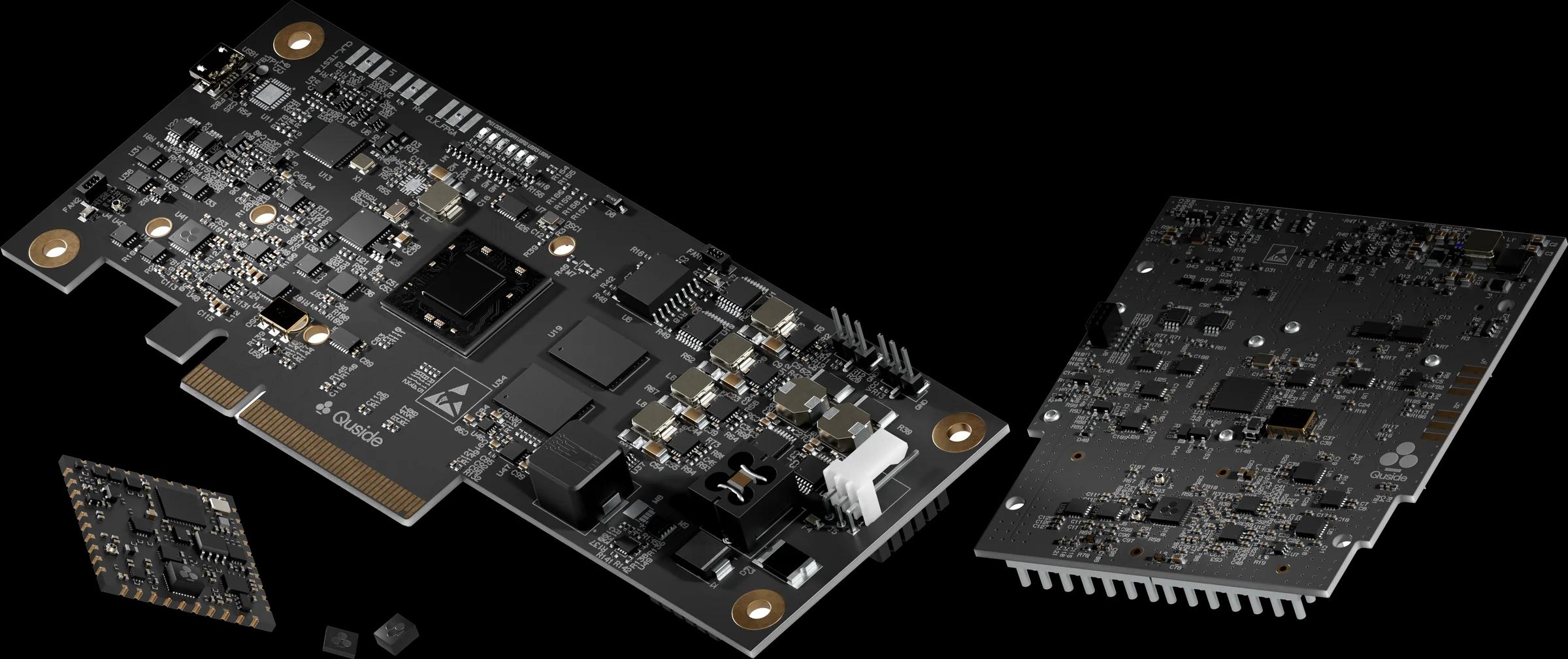
A network product family rarely has one form factor. The same entropy engine covers a server-based network function, an FPGA line card and a purpose-built controller, so one qualification effort serves the whole family.
| Position in the system | What it does | Quside part |
|---|---|---|
| Physical source | Quantum phase diffusion on a monolithic photonic chip for high-rate parts; polarisation switching from a VCSEL for compact, cost-optimised parts. Coherent supplies the VCSELs and material for the latter — the same device class used for face recognition and proximity sensing in phones. | Ruby™ N1 · Ruby™ S1 |
| Runtime measurement | On-device metrology measures the process against its model, estimates entropy and derives a health state, which is exposed to the platform as an audit output. | Built into every Quside entropy product |
| Server-class network element | Core network functions, security gateways and management platforms running on standard server hardware take entropy through a low-profile card. | Garnet™ Plus A41 with Linux C and Python drivers |
| FPGA line card or data plane | Where packet processing or cryptography runs in programmable logic, entropy is taken into the fabric directly. | Nellite™ Plus A41 with VHDL IP cores |
| Embedded controller or endpoint | For purpose-built equipment, the entropy source becomes a module on the board. | Onyx™ S1, built on Ruby™ S1 |
Evidence a regulator or an auditor can check.
You will have to justify these choices to a regulator or an auditor, so each piece comes with the scope it was issued under.
NIST SP 800-90B
- Scope
- Quside PCIe One and FMC One.
- Establishes
- The entropy source has been validated against the SP 800-90B requirements for entropy sources.
- What it does not cover
- It covers the entropy source, not a complete random bit generator, and not the systems built on top of it. SP 800-90C, final in September 2025, describes how a validated source combines with an approved deterministic mechanism.
ENS
- Scope
- Quside PCIe One and FMC One, version 1.0, under the Spanish national security framework.
- Establishes
- Qualification for use in Spanish public-sector systems categorised up to Alta, the highest of the three ENS categories.
- What it does not cover
- Covers Quside PCIe One and FMC One at version 1.0. Scope is per product and per version, so confirm the part number your programme is specifying against the catalogue record.
What the runtime evidence actually is
The loop runs in one order: physical process, measurement, entropy estimate, health state, audit output. That tells you whether the source is still behaving the way it did when it was validated, for as long as the equipment is in service — the signal a regulator or an auditor can be shown between certificate renewals.
Form factor and unit volume decide the part.
Start from the equipment itself. A network function on a server and a controller shipping in six figures rarely end up at the same part.
| Product | Choose it when | Integration | Entropy rate | Status |
|---|---|---|---|---|
| Garnet™ Plus A41 | The network element is server-based and you want the fastest route to a working evaluation on real traffic. | PCIe Gen2 ×4 · Linux C and Python drivers | Up to 1 Gbit/s | Available |
| Nellite™ Plus A41 | The data plane or crypto engine is an FPGA and you do not want entropy crossing a host bus to reach it. | FMC LPC/HPC and FMC+ · VHDL IP cores | Up to 1 Gbit/s | Available |
| Onyx™ S1 | The product is a purpose-built board shipping in volume, where board area, power and unit cost decide the design. | Embedded module · built on Ruby™ S1 | 50–100 Mbit/s | Available |
If the answer is “all of them, across a product family”, the relevant page is OEM and semiconductor integration, which covers how one qualification effort is reused as the design moves from modules to embedded parts to silicon.
What you can verify today.
The certificates and their scope can be checked independently. Put a unit on your own equipment for the rest.
An evaluation unit on your equipment, and a reference call
Operator and vendor references are given as calls under NDA rather than published, where a customer has agreed to take one. Alongside one, we ship an evaluation unit for your own network element and run a technical session on provisioning volumes, reseeding policy and the renewal path for your next product generation.
Other systems we build for
Start from the next product generation.
Tell us what you are specifying now and what it has to still be doing in 2035. Form factor, provisioning volume, the environment and the qualification target are usually enough for a first architecture review.