
Entropy that stays inside the platform, for the life of the platform.
Primes, integrators and programme offices need an entropy source that qualifies once, fits a payload budget, and can still show it is behaving correctly years after launch — without depending on anything outside the platform.
Who usually specifies it
- Primes and mission integrators
- Satellite manufacturers
- Secure communications teams
- Government programme offices
- Accreditation and assurance leads
What is driving it
Programmes here ask for more qualification work than any other segment Quside sells into: documented physical models, stated evidence scope, reusable test data. The same parts and the same evidence then carry into regulated infrastructure and volume products.
A component you cannot revisit after launch.
The environment moves, rework costs schedule, and the review board asks for evidence with its boundaries written down. A component that has to be trusted on assertion survives none of that.
Lifecycles outrun cryptographic assumptions
A platform designed now may still be operating in fifteen or twenty years. Whatever produces its key material has to remain trustworthy across that span, in an environment where a field visit is not an option.
The trust boundary ends at the platform
Sovereign and mission programmes cannot depend on randomness that arrives from outside the system. Randomness delivered as a service cannot be verified at the point where it is consumed, and it adds a link that the platform does not control.
Qualification is the schedule
Environmental, lifetime and security qualification is often the longest pole in a programme. A component with reusable evidence and a documented physical model is a different proposition from one that has to be characterised from scratch.
Size, weight and power decide the design
A payload or a mission-critical embedded box has no spare volume for a full-height card. The same assurance model has to be available at a much smaller footprint or it is not available at all.
Supply chain is part of the security case
Where the silicon is made, and whether that supply can be sustained across a long programme, is a question the programme office asks directly. Quside designs photonic and electronic chips, outsources fabrication, ships fully tested cards and runs production in-house.
Evidence has to survive the review
A programme review asks what was validated, under which scope and by whom, and what sits outside it. That is the form the evidence has to arrive in.
The systems this has to go into.
Different integration points and different qualification targets. In every one the entropy source sits inside the platform and has to account for itself.
Satellite systems
Payload and platform cryptography needs a trustworthy entropy source that will survive launch and years of operation, in a volume and power budget fixed early in the design.
Qualification evidence exists for Ruby™ N1 supporting operation in GEO conditions, and the same photonic engine is available as an FMC module for FPGA-based payload electronics or as a compact embedded module.
Nellite™ Plus A41 · Onyx™ S1 · Ruby™ N1
Secure communications
Link encryptors and secure radios generate session keys continuously in the field, where nobody is watching the health of the source and nothing can be replaced quickly.
A local source that measures the physical process against its model while it runs and reports whether it remains inside its validated operating conditions, so a health state can be carried in telemetry rather than assumed.
Nellite™ Plus A41 · Onyx™ S1
QKD infrastructure
Quantum key distribution systems consume very large volumes of random numbers, both in the quantum layer and in the classical post-processing around it. The random number generator feeding them is a component that has to keep up and has to be trusted.
A high-rate local source built for FPGA integration, which is where most QKD control electronics live. A QRNG is an enabling component of a QKD system, not a substitute for one; entropy on its own does not make a system quantum safe.
Nellite™ Plus A41 with VHDL IP cores
Mission-critical embedded systems
Ground segment boxes, avionics and deployed equipment need a root of trust and a secure boot chain in a form factor that fits an existing enclosure and an existing thermal budget.
A compact embedded entropy source sized for the enclosure and the thermal budget you already have. First Onyx units have shipped to defence customers.
Onyx™ S1, built on Ruby™ S1
High-assurance programmes
Accreditation asks for traceable evidence about the entropy source, not a marketing claim, and asks it again at every milestone. Evidence gathered for one programme should not have to be regenerated for the next.
A documented physical model, an SP 800-90B validated entropy source at a stated scope, and the ENS Alta qualification for Quside PCIe One and FMC One. Every claim comes with the scope it was issued under, so it survives being quoted back at you.
Garnet™ Plus A41 · Nellite™ Plus A41
QKD distributes keys. A QRNG produces randomness.
Quantum key distribution and quantum random number generation are often mentioned in the same sentence and are not the same thing. QKD is a method for distributing keys between two parties using quantum states. A QRNG produces the local randomness that a QKD system, like any cryptographic system, has to consume in large quantities.
Quside builds the second of those, and QKD equipment vendors are among the systems we build for. A QKD deployment needs a high-rate, local, measurable entropy source inside its own control electronics. That is the component Quside supplies.
Quantum entropy strengthens classical and post-quantum cryptographic systems by improving the quality and observability of the randomness they consume. It does not by itself make a system resistant to quantum attack. That is what the algorithms standardised in FIPS 203, 204 and 205 address.
The same engine, from ground segment to payload.
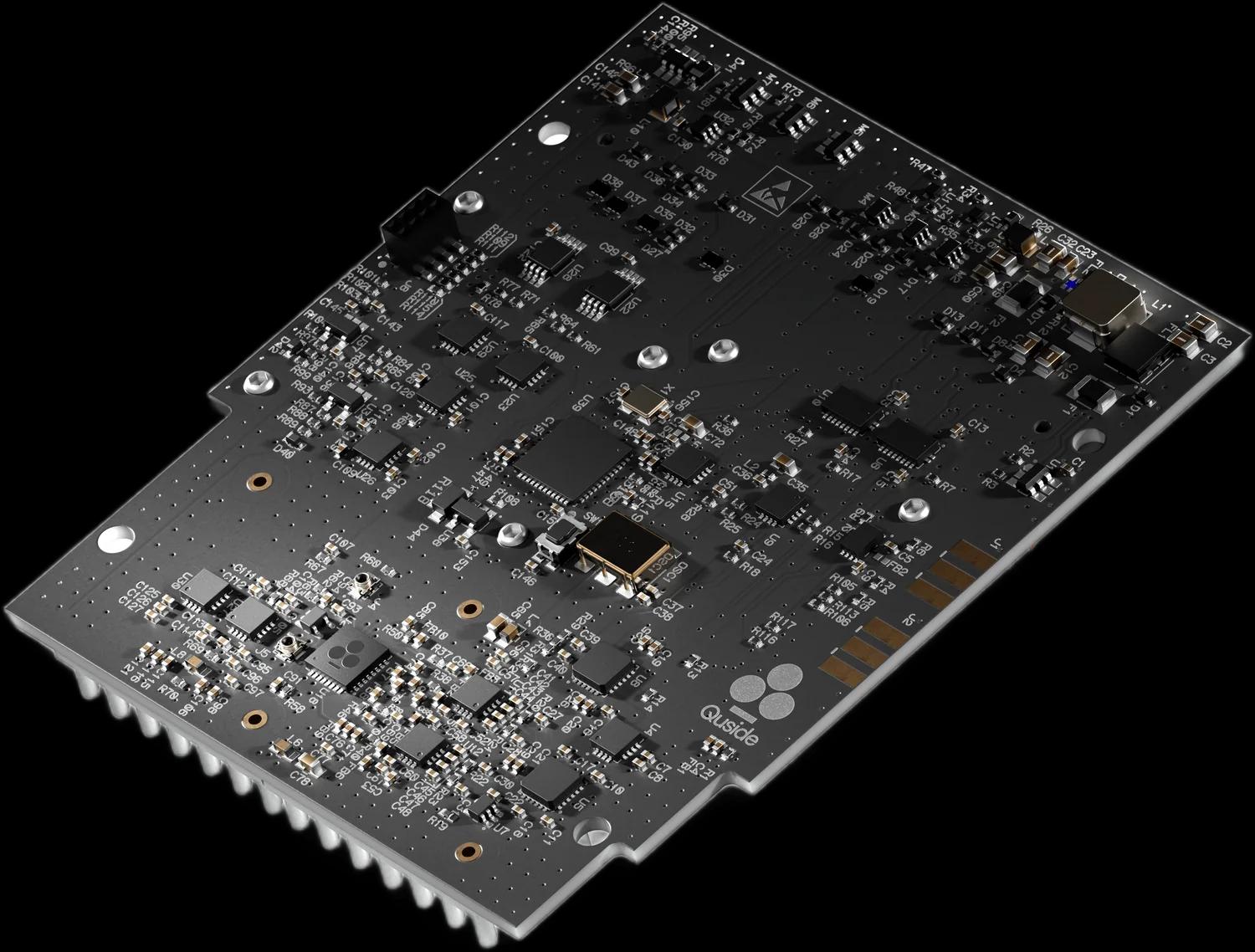
The same photonic source appears in a PCIe card on the ground, an FMC module in the payload electronics and an embedded module inside a deployed box. Sharing an engine is what makes qualification evidence and software effort reusable across the programme.
| Position in the system | What it does | Quside part |
|---|---|---|
| Physical source | Ruby™ N1 uses quantum phase diffusion: the optical phase of the laser field performs a random walk, driven by spontaneous emission, and interference turns it into an intensity the device digitises into bits. A monolithic photonic chip, with US and European photonic foundry supply, chosen for resilience. | Ruby™ N1 · Ruby™ S1 for compact modules |
| Runtime measurement | The device measures the physical process against a defined physical and statistical model while it runs, estimates entropy, derives a health state and makes it available as an audit output. | Built into every Quside entropy product |
| FPGA payload integration | Entropy is delivered directly into the FPGA fabric where the mission or QKD control logic runs, without a host processor in the path. | Nellite™ Plus A41 (FMC LPC/HPC and FMC+) with VHDL IP cores |
| Embedded platform | Where the system is a purpose-built board, the entropy source becomes a module on that board. | Onyx™ S1 |
| Ground segment and test | Server-hosted ground infrastructure, key generation facilities and laboratory benches use the standard PCIe card, so ground and flight share one entropy architecture. | Garnet™ Plus A41 with Linux C and Python drivers |
What is held, and what is programme-specific.
Each claim with the scope it was issued under, so it survives a review board.
NIST SP 800-90B
- Scope
- Quside PCIe One and FMC One.
- Establishes
- The entropy source has been validated against the SP 800-90B requirements for entropy sources.
- What it does not cover
- It covers the entropy source, not a complete random bit generator, and not the systems built on top of it. SP 800-90C, final in September 2025, describes how a validated source combines with an approved deterministic mechanism.
ENS
- Scope
- Quside PCIe One and FMC One, version 1.0, under the Spanish national security framework.
- Establishes
- Qualification for use in Spanish public-sector systems categorised up to Alta, the highest of the three ENS categories.
- What it does not cover
- Covers Quside PCIe One and FMC One at version 1.0. Scope is per product and per version, so confirm the part number your programme is specifying against the catalogue record.
Space qualification evidence
- Scope
- Qualification evidence supporting operation in GEO conditions.
- Establishes
- Environmental evidence for the entropy engine in that condition set.
- What it does not cover
- Evidence is programme-specific. Confirm the applicable scope with the programme team before citing it in a bid.
Supply chain and production
Quside is a fabless semiconductor and cybersecurity company. It designs the photonic and electronic chips, outsources fabrication, and runs production and final test in-house, shipping fully tested cards. Ruby™ N1 is a monolithic photonic chip, and photonic foundry supply runs through both US and European foundries, chosen for resilience. Bring the programme office questions on origin and continuity of supply to the engineering team directly.
Form factor and environment decide before entropy rate.
Start from where the cryptography actually executes, then check the rate sits comfortably above what the system consumes.
| Product | Choose it when | Integration | Entropy rate | Status |
|---|---|---|---|---|
| Nellite™ Plus A41 | The system is FPGA-based — payload electronics, a link encryptor, or QKD control logic — and entropy has to reach the fabric directly. | FMC LPC/HPC and FMC+ · VHDL IP cores | Up to 1 Gbit/s | Available |
| Onyx™ S1 | Size, weight and power dominate, and 50–100 Mbit/s is comfortably above what the system consumes. | Embedded module · built on Ruby™ S1 | 50–100 Mbit/s | Available |
| Garnet™ Plus A41 | The target is ground segment, a key generation facility, or a server-hosted element of the programme. | PCIe Gen2 ×4 · Linux C and Python drivers | Up to 1 Gbit/s | Available |
| Ruby™ chips | The programme is designing its own board and wants the entropy engine itself rather than a module around it. | Chip-level integration under a silicon discussion | N1 up to 1 Gbit/s | N1 and S1 in production |
What you can put in front of a review board.
Certificate scope is public and checkable. Programme references we arrange directly.
Reference calls and a technical review, under NDA
First Onyx units have shipped to defence customers. Where a programme has agreed to act as a reference, we arrange the call under NDA. Ask for certificate scope, the qualification evidence for your condition set, and a technical review with the engineering team.
Other systems we build for
Bring us the environment and the interface.
Volume, power, thermal envelope, the bus your cryptography sits on and the qualification standard you are being held to. That is normally enough for a first architecture review and a clear answer on which module fits.