
Cryptographic modules that run on entropy they can verify.
Quside builds a trusted hardware layer. Its modules perform critical trust and security operations — post-quantum offloading, root-of-trust functions, DRBG seeding — on top of a quantum entropy source that measures itself while it runs. One part, one trust boundary, one qualification.
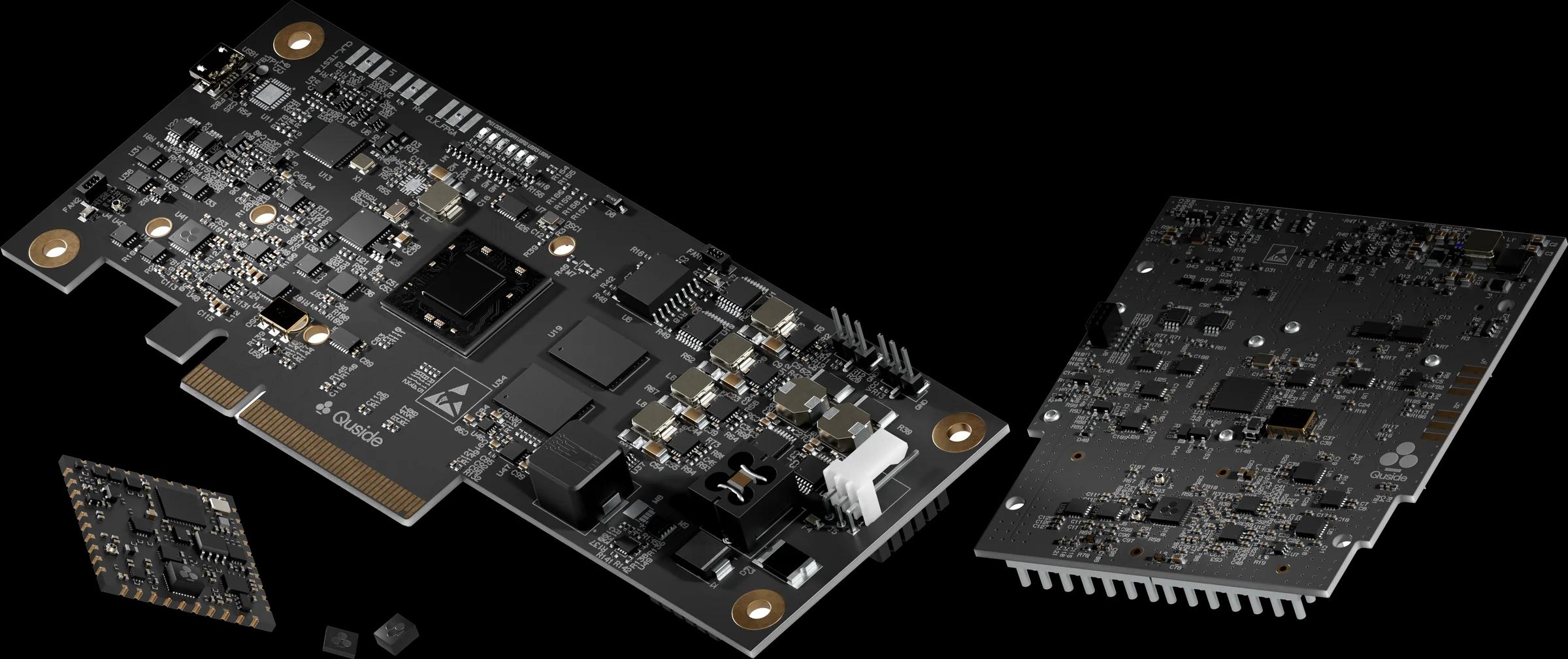
Cryptography is manufacturing.
Entropy is the raw material, algorithms are the machines, and silicon is the floor they run on. Three stages, in the order the questions get asked.
The entropy underneath, the operations on top.
Every Quside module is built the same way. A quantum entropy source underneath, cryptographic operations on top of it, and no bus between the two.
Quantum entropy
A photonic source built on a quantum process with a written physical model, and on-device metrology that measures that process while it runs — the Ruby chip family.
Locally Verified Entropy. The module reports its own health in service, so every operation above it draws from a source whose state is known.
How the entropy is generated and verified →Cryptographic acceleration
Post-quantum operations, root-of-trust functions and DRBG seeding, executed on the module itself.
Critical trust and security operations run in hardware, inside one boundary, next to the source that seeds them. Your host stops doing the work.
Which operations run on the module →What you can ask a module to do.
Each one executes on the hardware, inside your trust boundary.
Post-quantum offloading
ML-KEM and the standardised signature schemes execute on the module. Your host issues the operation and takes back the result, and the key material is produced in the same place the randomness came from.
Root-of-trust functions
Secure boot, device identity and platform attestation, anchored in hardware. Onyx X5 carries a Lattice MachXO5-NX root of trust in the same module as the source that seeds it.
DRBG seeding and reseeding
An approved deterministic mechanism seeds and reseeds from the source on the same part. Consuming logic can read whether that source is inside its validated operating conditions before it draws.
Verified entropy delivery
For a system that runs its own cryptography, the module delivers entropy and a live health state over the host interface. Garnet Plus A41 reaches up to 1 Gbit/s over PCIe Gen2 ×4.
SP 800-90C, final in September 2025, describes how a validated entropy source and an approved deterministic mechanism combine into a complete random bit generator. E178 covers the source half of that construction, for Quside PCIe One and FMC One.
The system designs this architecture lands in.
The architecture is the same in every case. The form factor, the throughput and the environment are what change.
Security appliances
Firewalls, VPN concentrators and secure gateways generating session keys continuously. A PCIe entropy source sits inside the appliance and inside its trust boundary.
Garnet Plus A41 · PCIe Gen2 ×4See the industry page →HSM and PKI systems
Key management and certificate authorities, where seeding, reseeding and availability are all part of the assurance argument.
Garnet Plus A41 · Onyx S1See the industry page →QKD and secure communications
Equipment that needs high-rate local randomness for basis choice and key handling, in systems already engineered around measurable physical processes.
Nellite Plus A41 · FMC LPC/HPC and FMC+See the industry page →Satellite payloads
Constrained power and mass, long missions and no route to a network entropy service. Ruby N1 has space qualification evidence supporting operation in GEO conditions.
Nellite Plus A41 · embedded integrationSee the industry page →Embedded roots of trust
Secure boot, device identity and platform entropy inside industrial, defence and networking equipment, where size, power and cost decide what is possible. First Onyx units have shipped to defence customers.
Onyx S1 · compact embedded moduleSee the industry page →
You are not integrating this on your own.
Start with a card in a slot and finish with a module on your own board. One photonic engine, one software stack and one set of health semantics carry the whole way, so the qualification work at the first stage still counts at the last.
Around the module, the layers a full system needs are already occupied. PQShield and Keyfactor build above it on post-quantum implementations and PKI. Lattice supplies the programmable logic a root of trust runs on. Coherent supplies the VCSELs behind Ruby S1.
- For a product team
- One module to qualify, one driver stack to write against, and evidence stated with its scope.
- For an OEM
- Qualify a standard module once, then move the same engine and the same software onto your own board.
- For an ISV
- A hardware layer under your algorithms that reports its own health, in accounts that ask for exactly that.
Where to go next.
The two layers in detail, and the path from an evaluation card to a shipping product.
Quantum entropy
Phase diffusion and polarisation switching, conditioning, and the runtime measurement behind Locally Verified Entropy.
Read the page →Cryptographic acceleration
Post-quantum offloading, root-of-trust functions and DRBG seeding, executed on the module and inside your trust boundary.
Read the page →Ecosystem and scale
Take the platform on its own, put it under software you already run, or buy the whole system as one solution.
Read the page →Tell us what you are building.
Interface, throughput, environment and volume are usually enough for us to say which module fits, which operations it can take on for you, and what the qualification work looks like.
Building cryptographic software?
Your algorithms are only as unpredictable as what seeds them. A module that reports its own health gives your customers an assurance argument they can check, and Quside sells into the accounts that ask for exactly that. If your layer belongs above ours, come and talk.