
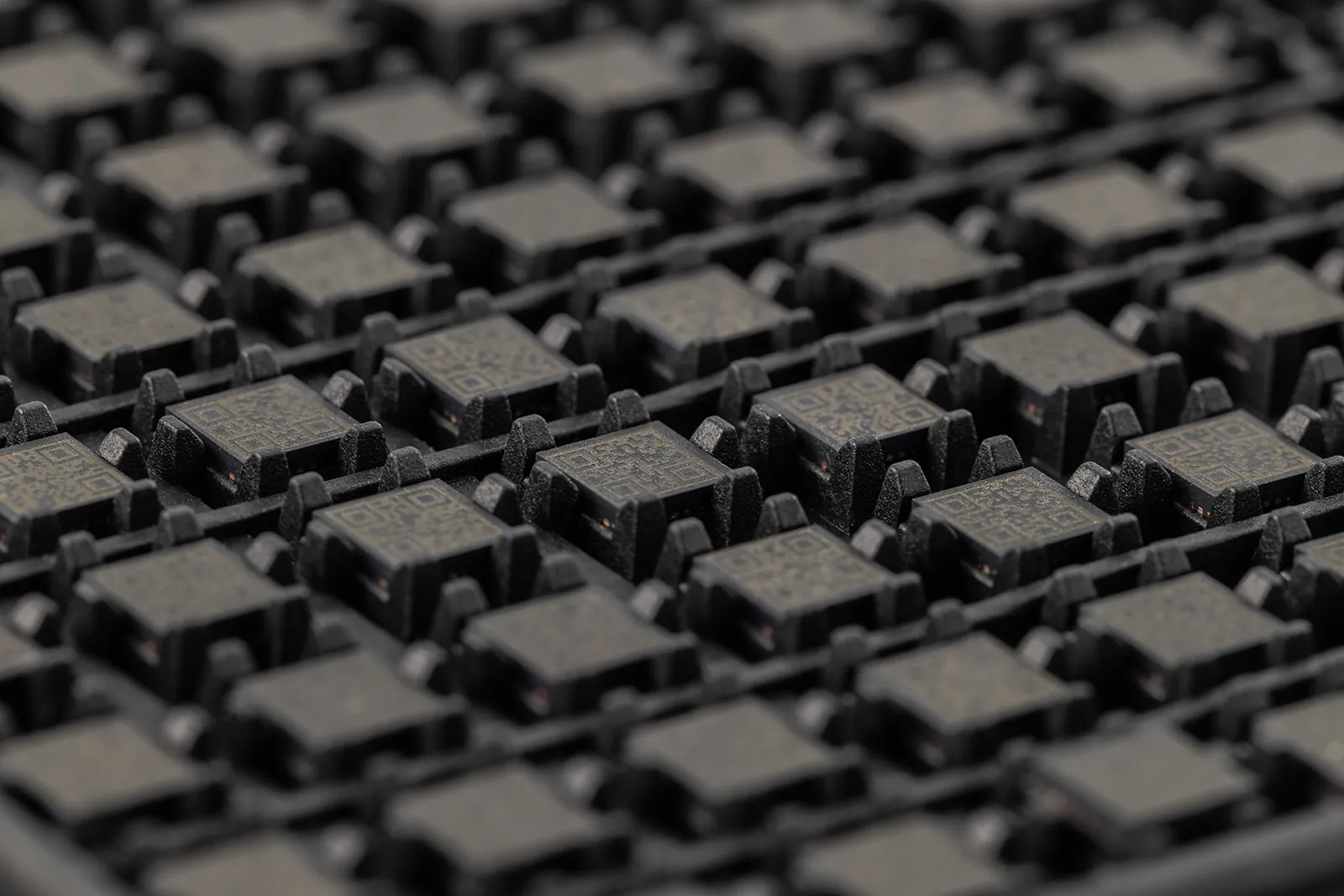
Cryptography is manufacturing.
Every key in your systems was made. It has a raw material, machines that shaped it, and a floor it was built on. Quside makes the raw material, inspects it, runs the line and seals the room — in a plant small enough to sit inside the device that needs it.
Every cryptographic operation follows industrial logic.
You source a raw material, you feed it into machines, the machines run on a floor, and finished goods come out the other end.
- Raw materialEntropy
A physical resource, harvested from a physical process. Not computed, and not produced by logic.
- MachinesAlgorithms
Key generation, encryption and signing. Classical today, with post-quantum schemes alongside them.
- Factory floorSilicon
The hardware the operations actually run on, and whatever else is running on it.
- Finished productKeys
Every identity, session and signature the business depends on.
The first box is the one people skip. Entropy is not a mathematical abstraction — it comes out of a physical device: thermal noise in a resistor, jitter in an oscillator, or in Quside’s case a quantum optical process in photonic silicon. Physical things drift, age, get too hot, and can be interfered with on purpose.
Anyone who has run a line asks the same questions, in the same order.
Is the raw material any good? Is the line efficient? Who else is standing on the floor? Three questions, three different objections, and the order is the argument.
- Stage 01
Is the raw material any good?
Every industry inspects what comes in the door. Cryptography consumes its raw material as it arrives, on the strength of a datasheet written years earlier.
The raw material→It answers“We already test our randomness.”
- Stage 02
Is the line efficient?
Entropy is made in one place and cryptography runs in another. The gap between them costs throughput, adds exposure, and turns one job into three procurements.
The production line→It answers“We already have a crypto accelerator.”
- Stage 03
Who else is standing on the floor?
Where cryptography physically runs decides who else can watch it happen. The answer is a sealed room, and keys are born in too many places for one room to serve them all.
The secure room→It answers“Can we not consume entropy as a service.”
Good material is where a factory starts.
Once the material is verified, the next question is where the machines sit. Once the line is efficient, the last question is what the room is made of. Once the room is small enough, you build one everywhere — and every one of them starts again at the material.
It is a sequence rather than a feature list, so the three stages are best read in order. Each one closes on a question worth taking into your own building.
Tell us what you are building.
Interface, throughput, environment and volume are usually enough for us to say which module fits, which operations it can take on for you, and what the qualification work looks like.
Building cryptographic software?
Your algorithms are only as unpredictable as what seeds them. A module that reports its own health gives your customers an assurance argument they can check, and Quside sells into the accounts that ask for exactly that. If your layer belongs above ours, come and talk.